To progress training intelligently, you need to understand the stress you are asking your body to absorb.
Adding another hour or another hard session tells us what changed on the calendar. It does not, by itself, tell us what changed for you.
Our endurance coaching uses FitLogic’s training intelligence through TriDot for triathlon and RunDot for running. We use it to inform the dose of training, the balance of stress and recovery, and the next step in your progression.
Your coach brings the part a metric cannot supply: a conversation about how you feel, what matters to you and what is happening in your life.
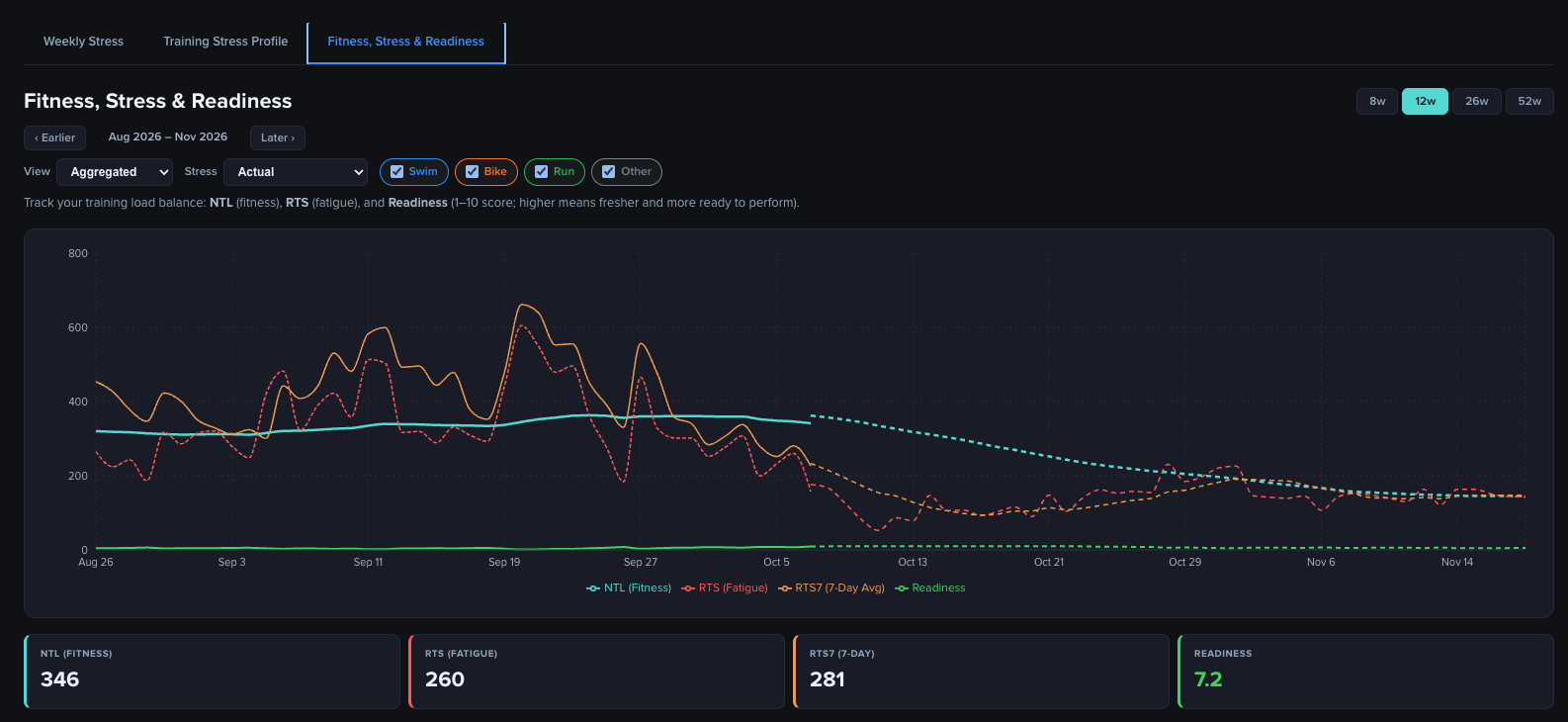
Fitness, stress and readiness: bringing training load and recovery into the same view. Select the chart to view full size.
THE DEPTH BEHIND THE DECISIONS
20+ years of data. Still learning.
Predictive Fitness, the company behind FitLogic, describes it as the “world’s richest endurance training dataset”. Built over more than two decades, it continues to grow as new training and outcome data are added.
The value is in the context. Conditions, individual characteristics, how sessions were executed and the results that followed help turn workout records into information that can inform training.
That is why we choose it: a continually developing foundation for personalisation, combined with a coach who knows you.
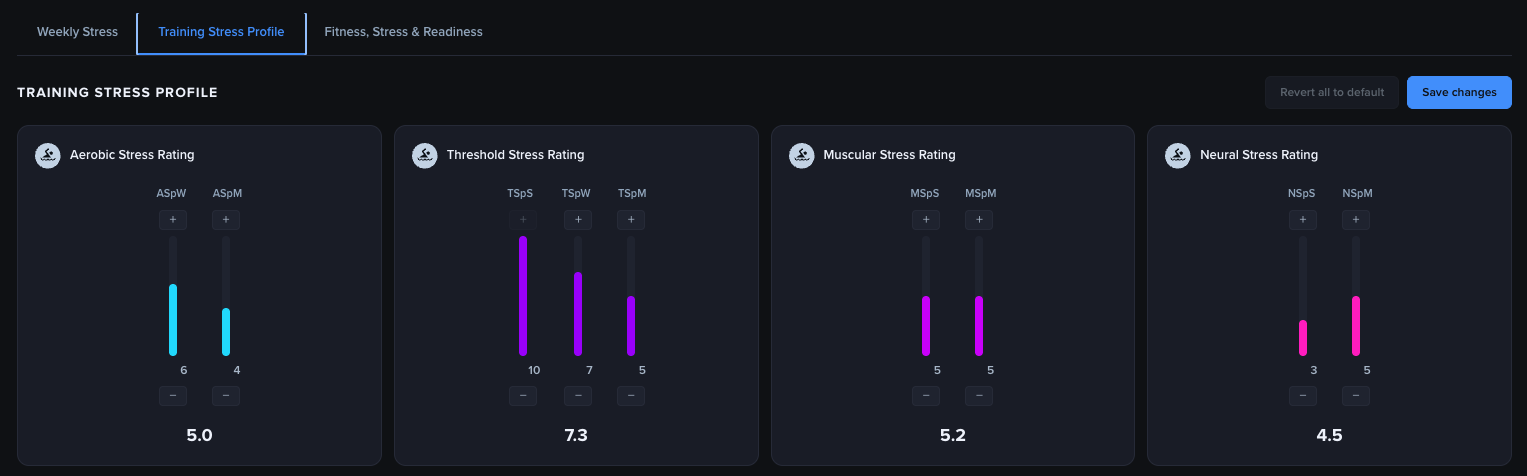
FitLogic’s Training Stress Profile describes an athlete’s capacity to absorb different kinds of stress across disciplines and timescales. The aim is to match training demands to the individual, rather than treating athletes with similar race times as interchangeable.
Performance in context
Dot Scores track performance within FitLogic’s framework. PersonAlign accounts for age and sex in its comparisons. Optional genetic information can also contribute through Physiogenomix; you do not need a DNA test to start coaching.
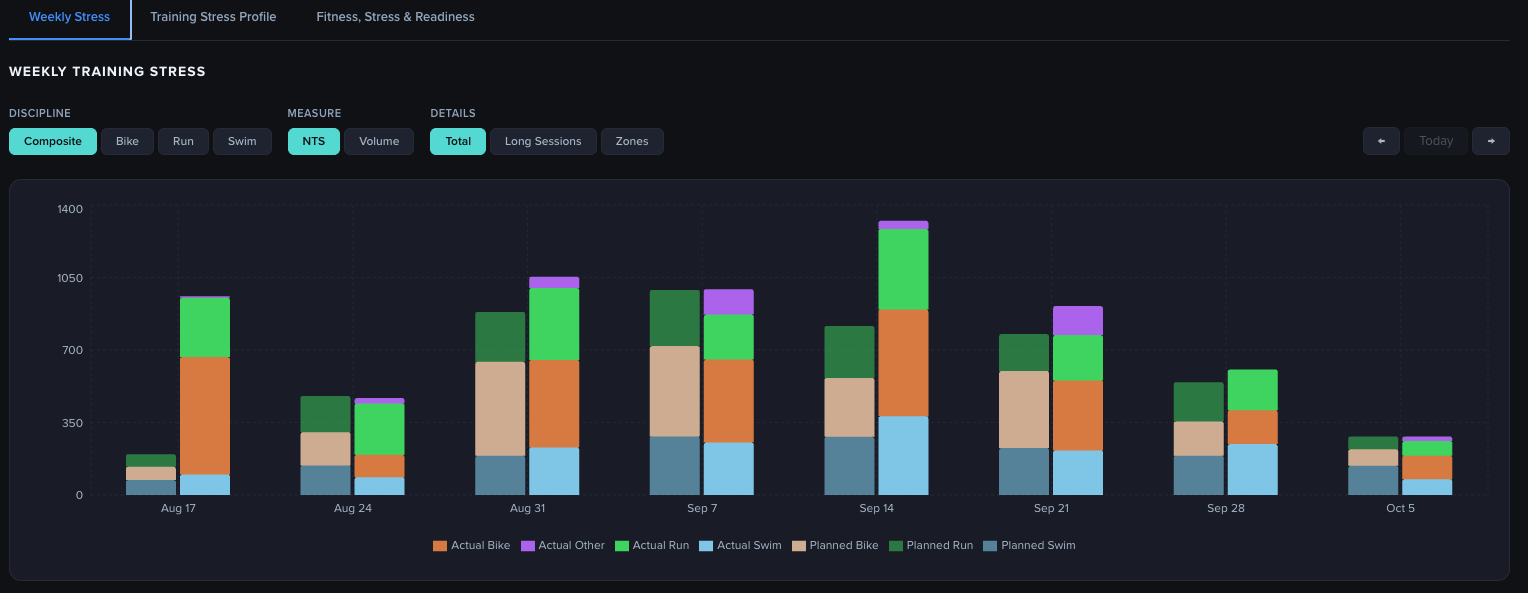
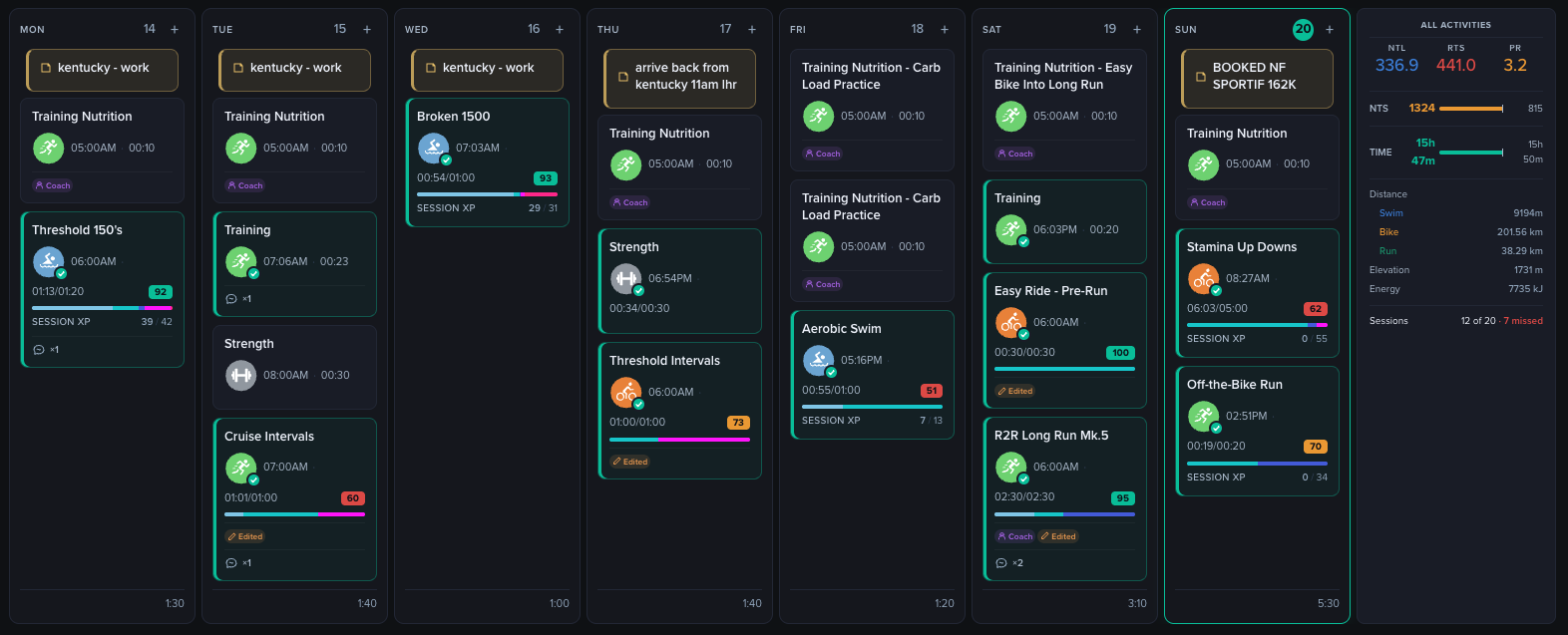
Weekly training stress: planned and actual NTS across disciplines. Select the chart to view full size.
NTS
What demand does this session create?
Normalized Training Stress is FitLogic’s model of a session’s physiological demand. It considers the discipline, intensity distribution, stress type, session composition, environment and the athlete’s stress capacity.
Why we use it: to plan and review the training stimulus, rather than judge a session by its length or average output alone.
Residual Training Stress models the lingering effects of previous sessions. Different types of stress dissipate at different rates, so finishing a workout does not mean its effects have finished.
Why we use it: to inform the timing and type of the next session, alongside your feedback about recovery.
Normalized Training Load represents training capacity within FitLogic’s model. It reflects sustained recent stress and is distinct from your ability to perform at a particular pace or power.
Why we use it: to inform progression. A higher load is useful when it supports your goals; chasing a bigger number is not the goal itself.
EnviroNorm accounts for environmental factors such as temperature, humidity, elevation and terrain. FitLogic uses this context both to adjust training targets and to interpret completed sessions.
Imagine your usual run on a cool morning, then the same route on a hot, humid afternoon. Holding the same pace can create a different demand.
Accounting for the conditions helps your coach distinguish a change in the environment from a change in your fitness. It also helps you aim for the intended training stimulus instead of forcing yesterday’s pace.
Illustrative example; the appropriate adjustment depends on the athlete and conditions.
WHY WE USE NTS RATHER THAN TSS
Useful in its day. Not enough for yours.
TSS was a useful step forward when it emerged around two decades ago. It gave coaches a practical way to combine duration and relative intensity. But it was never a complete model of an athlete’s physiological stress. Its usefulness as a summary did not remove its underlying limitations.
Those limitations are fundamental, not rounding errors. Matching TSS does not establish that two sessions deliver the same stimulus, impose the same recovery demand, or justify the same next session. Mistaking one for the other can undermine the entire progression of a training plan.
Our position is unequivocal: a metric can be useful historically and still be inadequate for the decisions we need to make today. Presenting TSS as a complete measure of training stress gives athletes false confidence. We expect more from modern coaching.
We choose NTS because of the additional context FitLogic is designed to incorporate. Used with RTS, NTL and your athlete profile, it gives our coaches a connected framework for planning load and reviewing its effects.
For Precision, chasing a weekly score is not progressive coaching. We want to understand the demand, how it accumulates and what you can absorb next. NTS, RTS and NTL are the framework we choose to inform those decisions.
Our commitment is clear: make progression an informed decision. Understand the intended stress, review your response and adjust, instead of adding work and hoping it is right.
FitLogic sets out multiple failure cases in traditional stress scoring, including session composition and recovery demands. Its argument is that errors in assessing stress carry through into prescription and progression. For Precision, these are serious shortcomings in the foundation of a training plan—not minor technical objections.
01
Steady work is not interval work.
FitLogic contrasts a 60-minute Zone 2 ride with a 42-minute session containing 12 minutes of Zone 5 work. Similar totals do not make the sessions equivalent.
The coaching mistake: swapping sessions to hit a number while changing the intended stimulus.
02
Finished does not mean recovered.
FitLogic distinguishes aerobic, threshold, muscular and neural stress, with different recovery patterns. One overall total does not describe that breakdown.
The coaching mistake: stacking demanding sessions because the weekly total looks manageable.
03
The weather changes the demand.
Power-based TSS has no direct temperature or humidity input. With unchanged power data and FTP, the calculated score is unchanged even when conditions differ.
The coaching mistake: assuming the same score means the same demand on a hot day.
Our position: understand the stress before increasing the dose. A tidy total is not enough to justify the next session.
Source: FitLogic’s published comparison. These examples challenge using TSS as a complete prescription; they are not independent outcome trials. Power-based TSS uses Normalized Power to account for variable effort, but does not separately report the different stress types described here.
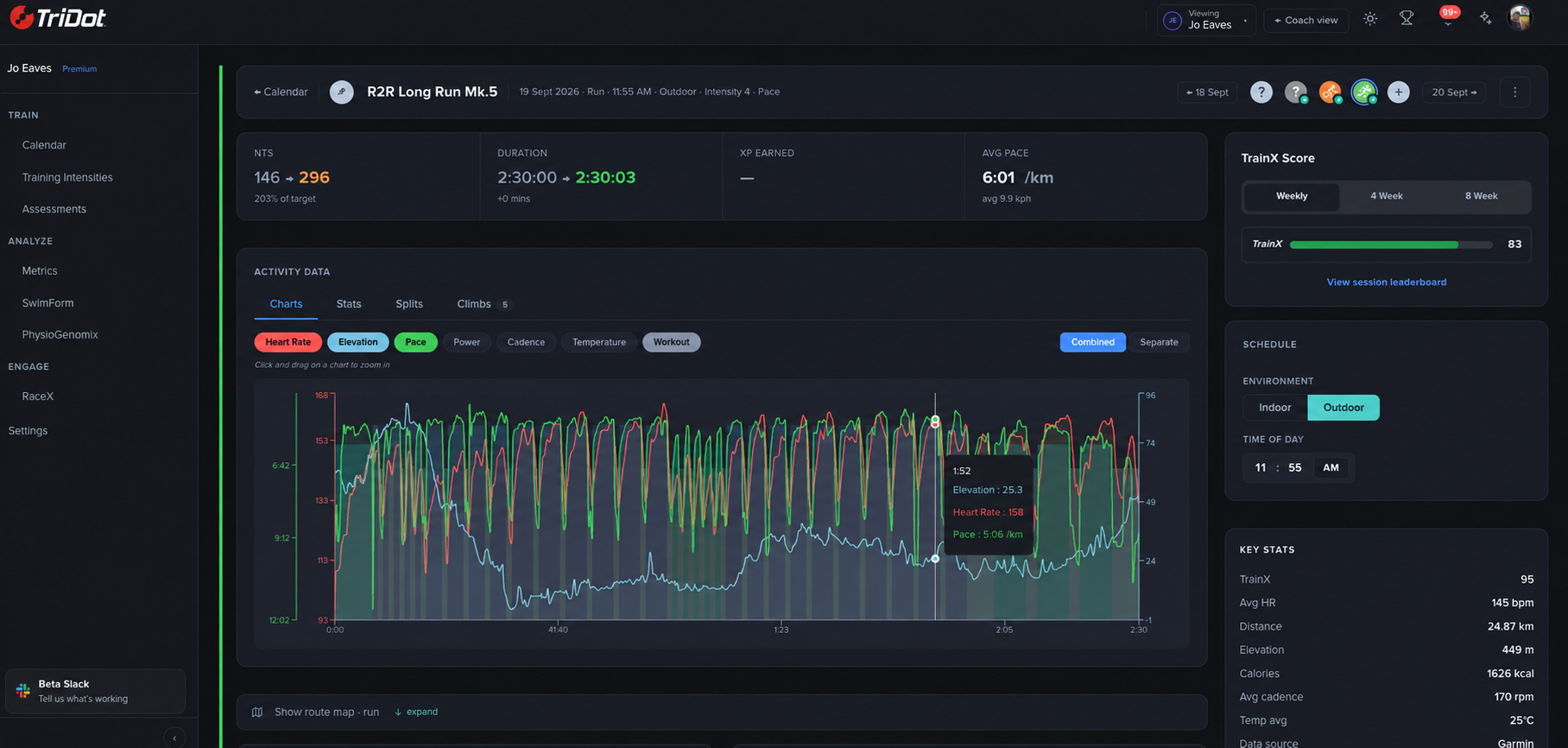
TrainX assesses how closely a session’s execution matched its intended purpose. Your coach can discuss whether an easy day stayed easy and whether key work delivered the intended stimulus.
Bring it to race day: RaceX
RaceX uses fitness and race conditions to inform pacing and predictions. Comparing expectations with outcomes feeds the wider learning process.
These are modelled estimates, not a direct measurement of every process in your body. Their usefulness depends on the inputs and how they are interpreted.
We combine them with your feedback, training history and the coaching relationship. If the numbers and your experience do not agree, that is a reason to investigate and adapt.